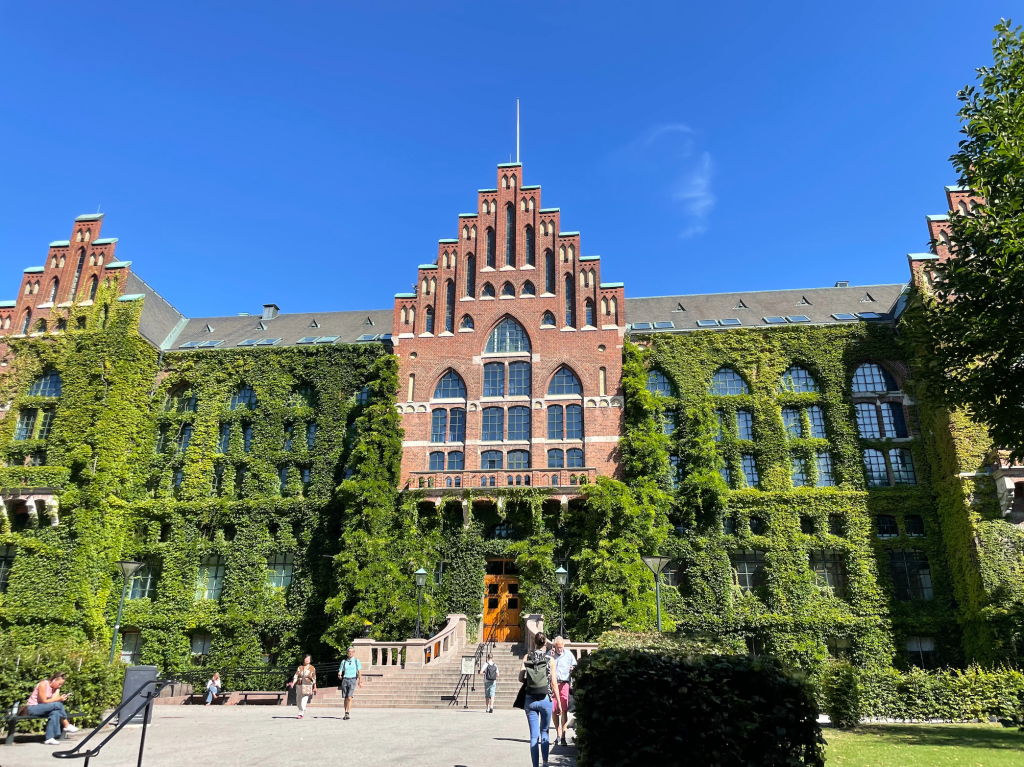
Earlier this week I (finally) had the opportunity to attend the Cycling and Society Symposium, this year hosted in the beautiful city of Lund, Sweden. I was grateful to present modal identity, a concept I’ve developed through my work on the conflict system of vehicular violence and the ideology of car supremacy, and through mobile participant observation with bike bus organizers in seven US cities and interviews with 24 participants across the country.
In the coursework portion of my doctoral program, every class I took covered some form of identity-based conflict. Whether it was religious beliefs or ethnic backgrounds, I’ve been conditioned to think of identities as inherent and/or generally immutable, and primarily as the way we describe ourselves. But my research suggests that these notions of identity might be limiting our ability to analyze the power and harm dynamics that play out on our public streets and in our public forums.
At the Symposium, I introduced modal identity as a distinct and salient identity category: the category along which privilege and priority are distributed in our mobility networks, and one that ultimately structures how we relate to one another while navigating our communities. I argued that the lens of modal identity helps us to understand how individual mobility technologies confer real advantages in size and speed, and how our durable built environment – together with the bureaucratic processes that yield to an ideology that treats the arrangement as not only inherent but logical – produces a hierarchy among road users. I discussed how someone who doesn’t internally identify with the mode they use can still have that identity ascribed to them.
I also explained how other aspects of identity like gender and racial/ethnic background intersect with modal identity…and not in the ways we might expect. For example, through my interviews I learned how several female bike bus leaders experienced aggressive encounters with male drivers while riding. Men on bikes in my data faced aggression from male drivers too, complicating standard narratives of gender and power. While gender gives us an important lens on these interactions, it’s modal identity that explains why they happen at all.
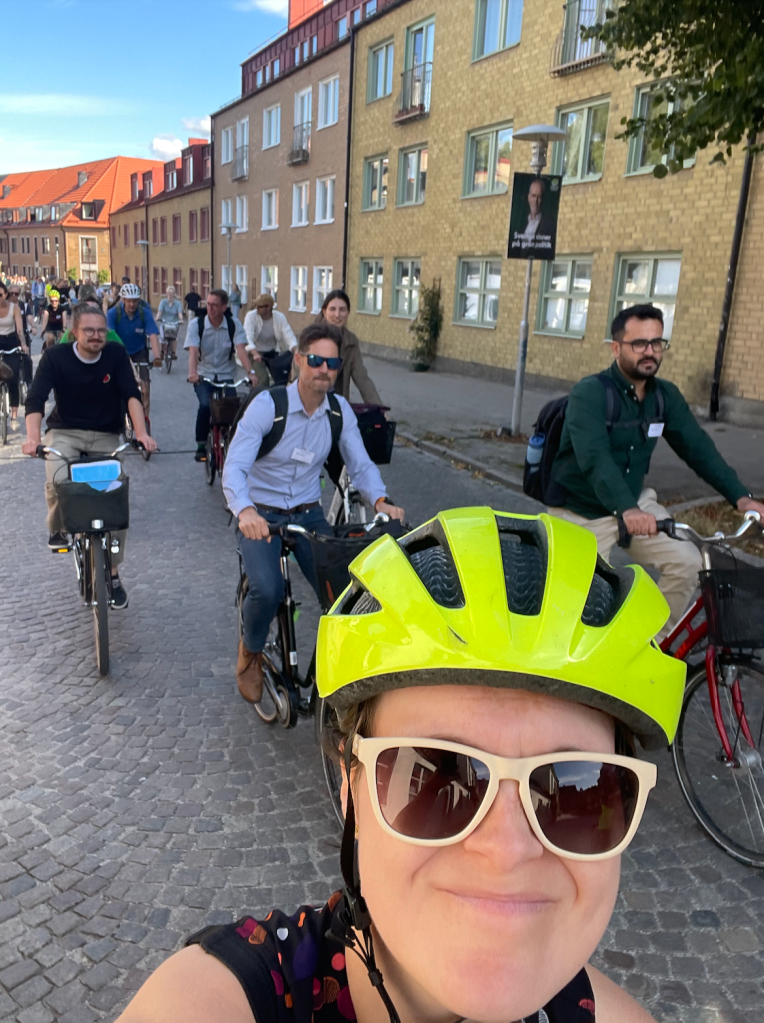
What struck me across the Symposium was how many sessions were tracing dynamics that modal identity names. For instance, hearing about the experiences of delivery workers highlighted how they rarely have political power to shape the streets they work on – particularly if they are from an ethnic minority or lower-income background. And yet, a delivery worker on a fast e-bike exerts physical power over people walking, a power imbalance that is only legible when we consider modal identity. That kind of resonance is a good sign for the framework, and I’m grateful to everyone who offered questions and feedback to help sharpen it as I continue developing it.
There is more to come on this line of inquiry but in the meantime, I invite you to get curious – what comes to mind when you imagine a peaceful transportation system? ☮️🚸


Leave a Reply