I recently read Jon Haidt’s The Anxious Generation and – like The Coddling of the American Mind and The Righteous Mind before it – found many of his points compelling. His main argument is that there has been a massive shift in the childhood experience (at least in the US and other higher-income countries) over the past 25 years thanks to the confluence of several innovations – portable screens (aka smartphones) that are always connected to the internet and continuously feeding us social media content peddled by companies trying to hack our brains (with especially disastrous consequences to the still-developing minds of youth) for profit. Whereas I spent my adolescence roaming the neighborhood, playing creative games with friends outside, and resolving small potatoes spats that emerged on the playground – in the process gaining critical social skills necessary for adult life – kids these days are missing out on an autonomous childhood that equips them with the know-how to navigate a complex world.

While it’s easy for me to say this as someone who doesn’t have the seemingly impossible task of raising kids in our screen-obsessed society, I wholeheartedly support his prescription for ensuring more kids get more play (especially given a recent study estimating one third of children don’t engage in afterschool outside play). That said, there were some points that I had qualms with.
One of Haidt’s recommendations to give kids more independence is to get as many of them driving as soon as possible. While I understand the motivation behind this – having to rely on caregivers for rides is no fun, and I can only guess how many soul-crushing hours caregivers spend coordinating pick-up and drop-off logistics or shuttling over-scheduled kids to endless activities (a task I imagine falls disproportionately on female caregivers) – this treatment misses the mark in so many ways. It fails to recognize that teen drivers are the riskiest age group behind the wheel, that teens are involved in a disproportionate amount of crashes, and that one of the reasons why kids aren’t playing outside as much is inherently connected to the dangers of our streets (stay tuned for a future blog post on the advocacy conundrum tied up in highlighting unsafe streets). I actually think we should make the legal driving age higher to account for the incredible amount of responsibility involved in driving a potentially deadly vehicle and the significant amount of brain development kids still have to do at 16. Rental car companies know what’s up when they prohibit drivers under the age of 21 from getting behind the wheel.
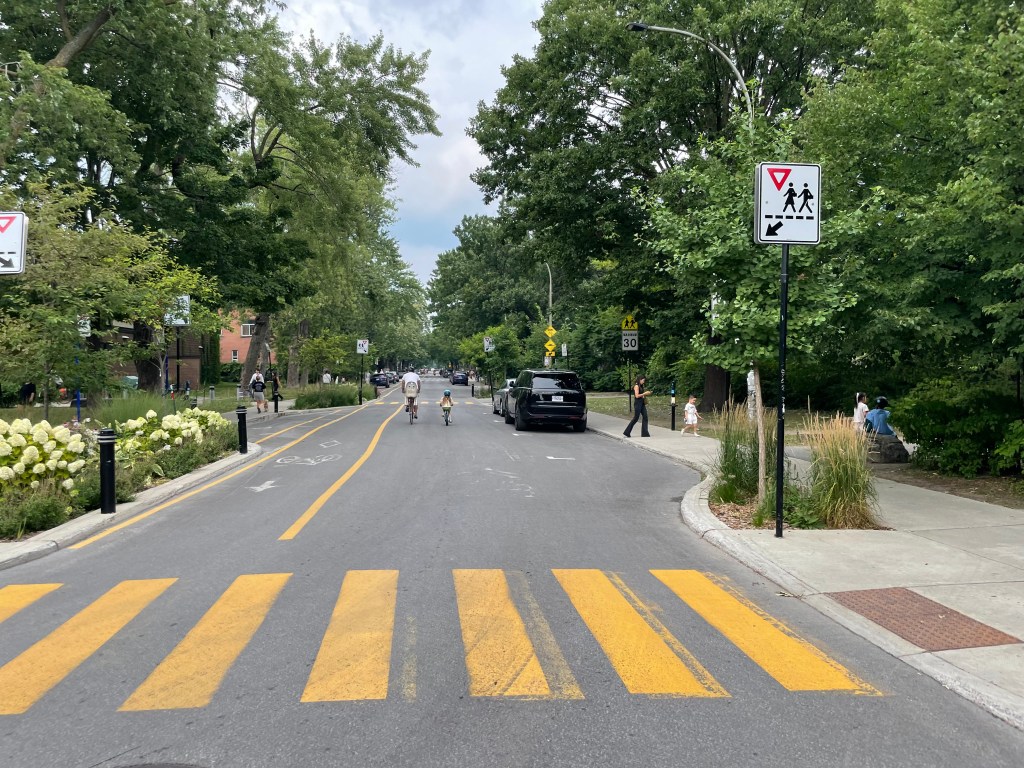
Another thing I wish he had done is to clarify what caregivers who want to “let kids play” should do if they live in an area where kids might not be able to do so safely given the risks posed by driving. While I know this may sound tone deaf given the hours spent chauffeuring mentioned previously, I think Haidt could have called for more parents to get involved in advocating for safe streets in their communities. Whether it’s creating a school street that is shut down to cars during pick-up and drop-off, organizing walking school buses (even if they only meet a few blocks from school), phoning elected officials to support proven car speed reduction measures like bulb-outs or speed tables, expressing support for automated traffic enforcement cameras, or sending an email to the local planning office to suggest where a protected bike lane is needed, there are lots of low-lift ways people can get involved in making our streets places where kids feel welcome.
While interviewing caregivers involved with bike buses, so many shared how they wished they could cross the major arterial that divides their neighborhood in two and pick up kids (usually of color) in the (typically lower-income) community just a few streets away, yet they didn’t feel safe doing so while also trying to shepherd a gaggle of twenty 7-year olds across six lanes of traffic. It makes me wonder how many Black and Brown kids in under-served neighborhoods go without play because no one has advocated for their right to the street…let alone given them an opportunity to share their thoughts for how our streets could be places where play was possible.
This isn’t to say that Haidt doesn’t make the connection between street safety and play – he seems to understand that the changes we’ve witnessed to our transportation networks and built environment play a role in enabling (or preventing) safe roaming. But what it does suggest is that we need to be a bit more thoughtful about the various reasons why kids might be staying in and how we might improve the built environment to reduce literal and figurative barriers to play entry.
This is not a point that others have missed. Twenty-five years ago, Robert Putnam blamed our drastic decline in social capital in part on TVs and car-induced/enabled sprawl. We’re now in a moment where we have to fight both at the same time as screens increasingly embed themselves in cars. Not only does this technological collision distract us from the important cognitive task of operating large, fast-moving machinery that comes within inches of other large, fast-moving machinery (or, in too many cases, small, slow-moving, unprotected human bodies), but it also gives us yet another way to tune out the world while we are simultaneously (ostensibly) in it. Ironically, for caregivers anxious about letting their kids out to play, the high-tech features cars are outfitted with do not seem to be making our streets safe for play.
I have one more observation about something Haidt referenced, but that will have to wait until next week’s post. In the meantime, I invite you to get curious – what comes to mind when you imagine a peaceful transportation system? ✌️🚸

 Peace and Planning
Leave a reply to Streets and The Anxious Generation Part II – Peace and Planning Cancel reply