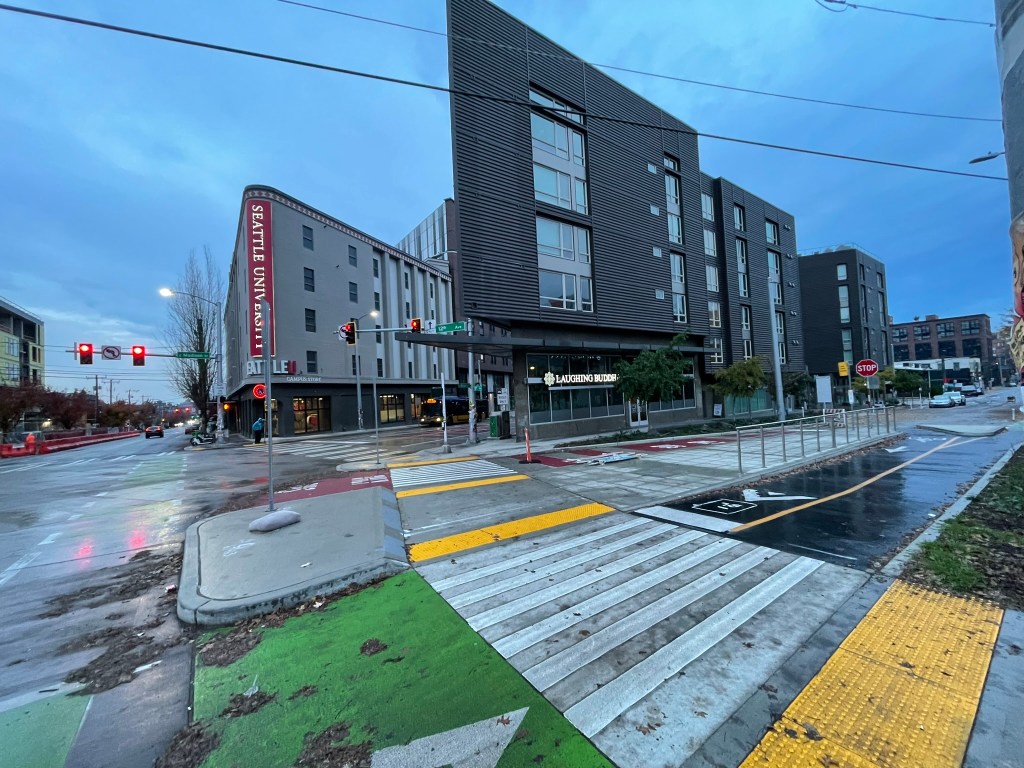
I recently had the privilege of attending the Association of Collegiate Schools of Planning annual conference, held this year in a place where it actually felt seasonably cool for fall (and had the foliage to boot): Seattle. I was a first-time attendee and I must say, it felt pretty darn amazing to get back to my planning roots, including reconnecting with some grad school professors I hadn’t seen in seven (!) years.
I was humbled to present my paper, “From Car Supremacy to Peaceful Streets: Shifting Power in Public Discourse” on the Big Ideas in Transportation Planning panel alongside a handful of impressive researchers. It gave me an opportunity to share a conceptual framework I’ve been working with for a while (car supremacy) and the empirical data I gathered through my dissertation research (critical discourse analysis of public witness testimonies at DC Council hearings on transportation) that supports my theorizing. While I’ve discussed car supremacy on this blog before, I’m noodling on a new definition – based on Ansley’s (1997, p. 592) definition of white supremacy (again, to be clear, I am in no way trying to equate white supremacy with car supremacy) – that is subject to change but gets closer to capturing the dynamics I’m investigating than the one I’ve used previously:
“a political, economic, and cultural system in which drivers overwhelmingly control power and material resources, conscious and unconscious ideas of driver superiority and entitlement are widespread, and relations of car dominance and non-driver subordination are daily reenacted across abroad array of institutions and social settings.”
This definition is instructive because it clearly distinguishes four different forces that comprise car supremacy. While the first prong (political, economic, and cultural systems) was largely outside the scope of my paper, I focused on the second prong (in which “drivers overwhelmingly control power and material resources” – which I shorthand to power consolidation) and the third prong (“conscious and unconscious ideas of driver superiority and entitlement are widespread” – which I shorthand to ideological beliefs). The fourth prong – “relations of car dominance and non-driver subordination are daily reenacted across abroad array of institutions and social settings” – was implicit in the fact that the public forum I examined was just one of thousands of similar public meetings that occur across the US every year, and in that the language that surfaced illustrated the second and third prongs (and is reflective of rhetoric that often emerges in those thousands of public meetings anytime challenges to car supremacy are proposed).
Researching car supremacy is no easy task as “particularly dominant ideas can achieve the status of being beyond critique through becoming ‘common sense’ (Fairclough, 1989; as quoted in Egan and Caulfield, 2024, p. 3).” Using Critical Discourse Analysis thus allowed me to peel back a few layers of the normative construct I propose in my conceptualization of car supremacy. The first layer is a term I’ve alluded to on Car Blanche before: modal hierarchy, which illuminates the power consolidation piece mentioned earlier. Previous references I’ve made to it haven’t been very detailed, but the language used by folks on either side of the debates I examine was helpful in bringing some clarity to the concept.
My data was split into two segments: testimonies of maintainers (those who opposed reductions to the speed of or space allocated to cars) and testimonies of reformers (those who supported reductions to the speed of or space allocated to cars). On the left in the graphic below is my translation of how maintainers understand the modal hierarchy, which gives the most privileges to the speed and storage of private vehicles and offers subsequent groups (roughly proportional to how much it seemed maintainers used those modes of transportation) fewer and fewer resources. On the right is my interpretation of how reformers conceptualize the modal hierarchy, which recognizes the outsize privileging of the speed and storage of vehicles over all other modes of transportation. In both cases, the needs of drivers reign supreme, but each posits a different reason as to how that power relates to the system. The first sees that power as inherent to and a justified byproduct of the existing mobility system (since our current transportation system prioritizes the needs of drivers over all others, and in turn makes it the dominant mode of transportation) whereas the second views this power as the generator of the existing mobility system (which in turn creates its inequities).

This brings me to the second layer: modal marginalization, which reveals the ideological beliefs piece mentioned earlier. I argue that the narratives used by maintainers reveal their ideological beliefs about who belongs on our public rights of way through delegitimizing the safety needs of people who roll (with consequences for all road users) and claiming the non-representative nature of reformer feedback or painting reformers as not reflective of the “community.” I offer just two quotations below to illustrate these points.
I keep hearing that justification for adding bike lanes to slow traffic on Connecticut Avenue to make it safer. We don’t need bike lanes on Connecticut Avenue to make it safer. Bike lanes will actually make the avenue less safe by causing confusion for drivers, bus passengers, zoo visitors, and pedestrians. 7,000 cars per day diverting into neighborhood streets will make the side streets more dangerous too, especially for children. (Testimony 25)
It’s a war on cars. It’s a war on drivers. It’s a war on the disabled. It’s a war on the tax paying residents in the neighborhood. Pause these bike lanes now. (Testimony 51)
In the first quotation, we see the commenter concede the dangers posed by cars right after claiming the bike lanes are to blame. In the second quotation, the public witness implies that no one who would support the bike lanes could possibly be a tax-payer or a resident of the neighborhood.
Both maintainers and reformers talk a lot about engagement and safety, though it’s clear that with a closer read they interpret these principles very differently. There is a LOT more I could share on these themes – as well as the dozen or so others that emerged through my analysis – but my hope with this post is to put forth a challenge to the planning profession: What would building peacebuilding into urban planning practices look like? How can you counter car supremacy in your engagement and planning processes? What do we all lose when you don’t?
For everyone else, I invite you to get curious: What comes to mind when you imagine a peaceful transportation system? ✌️🚸

 Peace and Planning
Leave a reply to On sins – Peace and Planning Cancel reply