Over the past few years, I’ve been fortunate to present my work at several conferences spanning various disciplines – planning (x2!), geography, political science, peace and conflict studies, international studies, and urban studies. While traveling to five in a 12-month period isn’t for the faint of heart (read: me), I enjoyed the challenge of trying to make my work legible to such a diverse range of scholarly backgrounds. What I especially appreciate about conferences is that people choose to come to your session – even if not for your specific presentation – which means the audience is broadly interested in the panel topic, somewhat knowledgable about it, or is at least marginally open to being exposed to findings related to the theme.
As anyone in this nook of the world of transportation research knows, we aren’t always the most popular person in the room. I recently had the new experience of being in a room with 40 other grad students (and that was just the first half of the contestants) – and dozens of judges roaming around – where we were all presenting our work at the GMU Research Poster Competition. I left with two observations:
- On nutshells: Coming to a space where you can infer nothing about your audience is even more challenging than trying to translate your work to a field you’re not fluent in. Whereas conferences at least allow me to presume a modicum of lukewarm reception of or familiarity with or interest in my topic, I was coming in completely cold here. That in and of itself isn’t new (see point above about being the least desired conversation partner at parties) but what was new was being in a space where I was coming in cold to an ostensibly academic audience (judges were largely from different university departments). Where should I even start? I’m sure all students had a similar feeling, but if you say “AI and education” when someone asks you to sum up your research in a nutshell, that gets them 80% of the way there. Me saying “transportation” can conjure up all sorts of ideas, with the likelihood of any being remotely related to my research being approximately 0% (and swinging the pendulum in the opposite direction by answering “the conflict system of vehicular violence, the ideology of car supremacy, and streets as sites of social movement and peacebuilding” fares, as you can imagine, just as poorly). Alternatively, someone researching a mathematical theorem might not have work that is easily intuited for a layperson (me, for instance), but at least that mathematician doesn’t then have the unfortunate job of telling the judge that they are part of a society-wide moral failing. I am thus left to wonder: how do I a) introduce people to a concept they’ve never encountered before, b) show them that their first interpretation isn’t quite right (nope, I don’t care about traffic), c) convince them it’s a problem, d) do all that while tactfully sharing the notion that they are likely part of the problem, and e) do that all so well that they walk away wanting to change their behavior, or at the very least think about it more critically? (As you may be able to gather at this point, I had no hopes of winning the poster competition.)
- On eggshells: This is a tricky act to pull off, especially since while I can make an educated guess, I can’t be fully sure until I’m done with my pitch where someone falls on the spectrum of “wait, what do you mean cars are bad?” to “I got my copy of Life After Cars last week.” In my case, I had two (of three!) judges whose first question after I talked about my dissertation was, “So what would you say to someone like me who can’t stand when cyclists are riding in the middle of the street?” This is where the eggshells come in because even though what I wanted to say is “Well, first I would ask if you’ve listened to anything I’ve said for the past three minutes,” that’s clearly not going to go over well. My goal is to first open their mind and second to push it just enough to expand it without breaking it. Which is to say, if I push too hard or in the wrong way, I could either make them dig their heels in more or reinforce their stereotypes of people who bike (I would say “or walk,” but as discussed elsewhere, that’s not the threat).
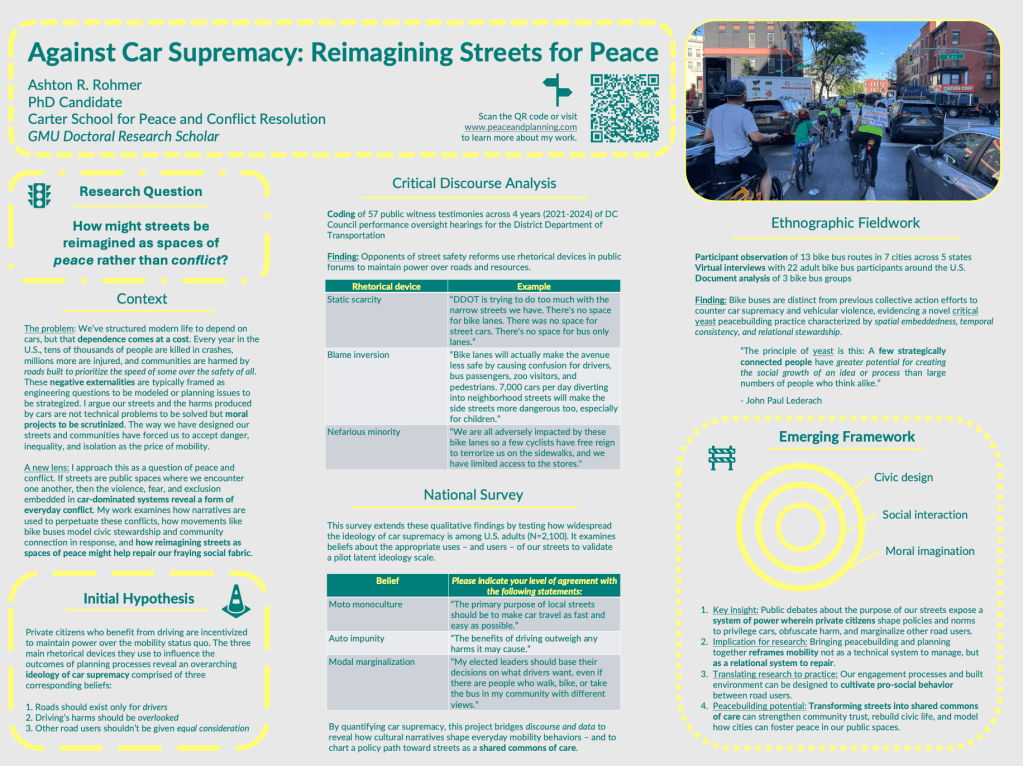
There was a third judge, though, and she was the miraculous audience member who was not only open to my research and understood its importance, but also *got* that it actually wasn’t about bike lanes. Unfortunately, the reason why it resonated so clearly was because a friend of hers riding a bike had been killed by a driver. Given how common fatal and life-altering crashes are, I usually expect someone to have this experience, although never assume it has shifted their worldviews (I’m always surprised how often it doesn’t). This encounter made me rethink the experiment I had tried to engage the judges at the start of my pitch with a morbid morning pop-quiz: how many people are killed in crashes on US roads every year? (an average of 40,000) How about globally? (over 1 million) How about since the advent of the automobile? (60-80 million). While the N=2 experiment yielded interesting results (people are uneducated about these facts, although maybe the third judge who lost a friend – who hadn’t been there for the quiz – would have done better), starting on such a grim note, particularly given how many people are personally impacted by car crashes, might achieve a shock factor but is not the most thoughtful way to introduce my research.
This experience made me realize that what I usually consider as a liability of communicating my research – knowing how to unpack the many layers that constitute car culture and its devastating effects – could actually be an entry point. I’ve long wanted to try a party game (although maybe not at the current parties I go to – see above) where I ask people to give me a topic and I come up with a connection to cars. I realize I know far too little about pop culture (or really anything outside of my little corner of the world) to actually be successful at this, so maybe if I ever attend a research poster session again I will instead start by asking judges, “What is an issue you care deeply about?”, and then show them the way. In the meantime, I invite you to get curious – what is an issue near and dear to your heart…and how could you imagine a peaceful transportation system helping to address it? ✌️🚸
 Peace and Planning
Leave a comment