I recently read a fresh-off-the-press journal article written by a group of scholars from across the world on the “state of the art” in transportation policy research. They first searched more than 8,000 abstracts from three leading transportation policy journals to determine the 20 categories most commonly referenced in the articles. Then they invited an expert in each of the 20 categories to look beyond those three journals and give an overview of the latest and greatest in that category. The resulting piece, “The Hitchhiker’s Guide to challenges in transport policy research: Towards ANSWERing questions regarding life, mobility, and everything” was published in Transportation Research Part A.
At first glance, I was excited to read this – I love these 30k-foot-view-of-the-field review articles. However, I quickly grew suspicious of their ambitious claim that they were offering an answer for “everything” – the more I read, the more I questioned that even their answer for mobility was what we should be promoting in policy circles. While I appreciate the spirit of the article, it raised several red flags (well, if you were to see how much grumpy marginalia I scribbled you’d know “several” is an understatement) – below are just the first seven that grabbed my attention:
- It appears none of the authors hail from a school of public policy – nearly half seem to be in technical or transportation academic departments (three are in geography departments, though none appear to be in planning).
- This bias towards technology is evident in their ANSWER framework, where three of the six letters in the acronym relate to technology (Adaptability – to technological advances, Network integration – notably, of new modes like drones and AVs, Wireless connectivity – to incorporate more advanced technologies…the remaining letters are sustainability, equity, and resilience, of which both equity and resilience are also their own category among the larger set of 20).
- Land use is not included as one of their categories despite its significant relationship to transport policy.
- I’m burying the lede here a bit but I was surprised at how much pro-car bias was embedded in all the topics related to road transportation. For example, an entire section is dedicated to parking management – which readers, I assume, are supposed to understand as car storage rather than parking for other modes – and not one dedicated to curbside management. There are factual inaccuracies (“Public authorities manage parking to disincentivize car use” – perhaps that happens somewhere, but certainly not where I live) and wishful thinking (“Parking policies…tend to…have higher levels of public acceptance” – I suppose this does not include any policies to reduce parking given how supremely unpopular removing even *one* space can be…which is perhaps why the article does not explicitly mention the growth in parking reform efforts to abolish parking minimums). There is also an alarmingly tone deaf approach to serious safety concerns: “Contemporary parking management thus may involve substantial investment in retrofitting and reinforcing aging infrastructure. This is especially true of multi-story car parks built in the 1960s/70s which may be nearing the end of their intended service life and which are too small to accommodate the increase average size and weight of private cars.” Not only does this not explore the radical question of whether such parking infrastructure should be rebuilt at all, but it of course also completely neglects the issue of car bloat and how irresponsible it is to promote incentivizing dangerous design through infrastructure that will last for another 50 years.
- The experts seem to think that the biggest barrier to women riding bicycles is “the fear of not being able to solve a mechanical failure.” I won’t even begin to engage on how this fails female riders on so many fronts, but consider me enraged.
- They commit the same oversight I covered in my previous post of not articulating what they mean by vulnerable. In their section on “equity in transportation” they take great pains to detail all of the groups that may be considered vulnerable: “Basically, it boils down to two groups: the vulnerable or disadvantaged group and the non-vulnerable or advantaged group. Each group may be further divided into sub-groups, such as ‘the most vulnerable among the vulnerable.’ Common classification criteria include age (e.g., the very young and very old as vulnerable), gender (e.g., females as vulnerable), race (e.g., minority as vulnerable)…” with four other classifications outlined as such. And yet, nowhere do they talk about what these road users are vulnerable to, what made them vulnerable, how they distinguish between vulnerable and disadvantaged, or how these different characteristics might intersect with each other.
- In the same equity section, the authors note that “transport equity suggests that more (public) resources should be spent to support the vulnerable population so that they can overcome their disadvantages.” How about “…so that the legacy of unjust and insufficient government spending to support people made vulnerable to cars can be ameliorated”? Or “transport equity suggests that fewer public resources be spent on driving so that people from historically under-served groups have safe, dignified, affordable, and easy access to other modes of transportation so they can fully participate in society”?
So, what do I make of this truncated list of observations?
- We need to build a subfield of transportation research – I like the sound of critical transportation studies – to ensure that we are grappling with the true costs of our current mobility paradigm and forcing hard conversations about what we want our society – and streets – to look like. We need to meaningfully examine what injustices exist, where they are most pronounced, what caused them, and how to mitigate them. And while there’s obviously a lot to unpack as it relates to our relationship with cars, there is plenty to explore when it comes to other modes of transportation (how buses are stigmatized while trains are not, or what people riding bikes owe pedestrians…or how pedestrians treat people riding bikes).
- We need to ensure that a subfield like critical transportation studies doesn’t get siloed in purely theoretical spaces or stuck at the fringes or assumed to be “soft” (heaven forbid it leans on qualitative research). We need to be in policy journals so that the people in positions of most authority are confronted with inconvenient truths about their decisions and we need to be in debates about how politics and power can be harnessed to create better outcomes for society.
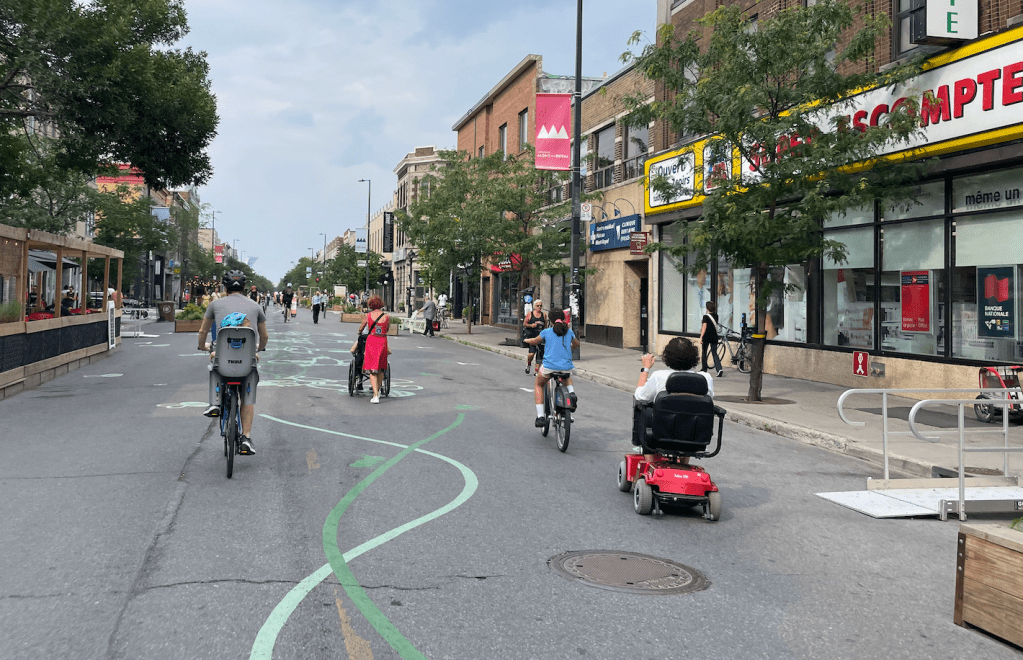
For academics with the privilege of doing research and having a platform to share it, there is too much at stake – too much harm, too much marginalization, too much lost opportunity – to not take an unflinching look at our mobility networks. We must resist the urge to avert our gaze because of how intractable of a problem it seems to be, or because of how unpopular such a perspective will make us, or because of how difficult it will be to get funding or justify our work or convince people of something they cannot – or will not – see. We cannot accept rapidly advancing technologies as foregone conclusions. We cannot shirk our ethical responsibilities for conducting clear-eyed research. We cannot neglect our moral responsibilities for carrying out full-hearted critiques of systems that leave us all worse off.
Critical transportation studies needn’t only be left to philosophers or theorists or even scholars, but we must be at the forefront of this discourse lest we lead our policymakers down a dead-end street. There’s plenty of work to go around – will you join me? In the meantime, I invite you to get curious – what comes to mind when you imagine a peaceful transportation system? ✌️🚸
 Peace and Planning
Leave a comment