As mentioned in my previous post, I recently had the good fortune of being able to attend the 2025 Association of Collegiate Schools of Planning annual conference, this year held in Minneapolis (stay tuned for a post on my thoughts about the Skyway system). I got to present some dissertation research, see folks I met 10 (!) years ago when I started my master’s in planning at UNC, get to know colleagues I’ve connected with more recently, and meet new scholars pursuing interesting work (oh, and visit the coolest place ever).
One of the sessions I attended was titled “Navigating the Complex Dynamics of Accessibility, Safety, and Mobility for Vulnerable Road Users.” As anyone who has read my last few blog posts knows by now, I think a lot about notions of harm, intentionality, and – by extension – vulnerability. Ever since Darren Buck got me thinking critically about the term “vulnerable road user,” I’ve grown increasingly weary of it. While I appreciated the intent of the panel, it was a good example of my current discomfort with the term – we so often neglect to specify what those road users are vulnerable *to* (Cars. Full stop.) and *why* they are made even more vulnerable (policies, planning outcomes, car design, driver behavior, etc.) on our streets. If my notes and memory are correct, it took a few session speakers for this to be implied and even then, I don’t think there was ever an explicit reference made to what exactly was meant by “vulnerable road user” generally or specifically for the purposes of the session discussion.
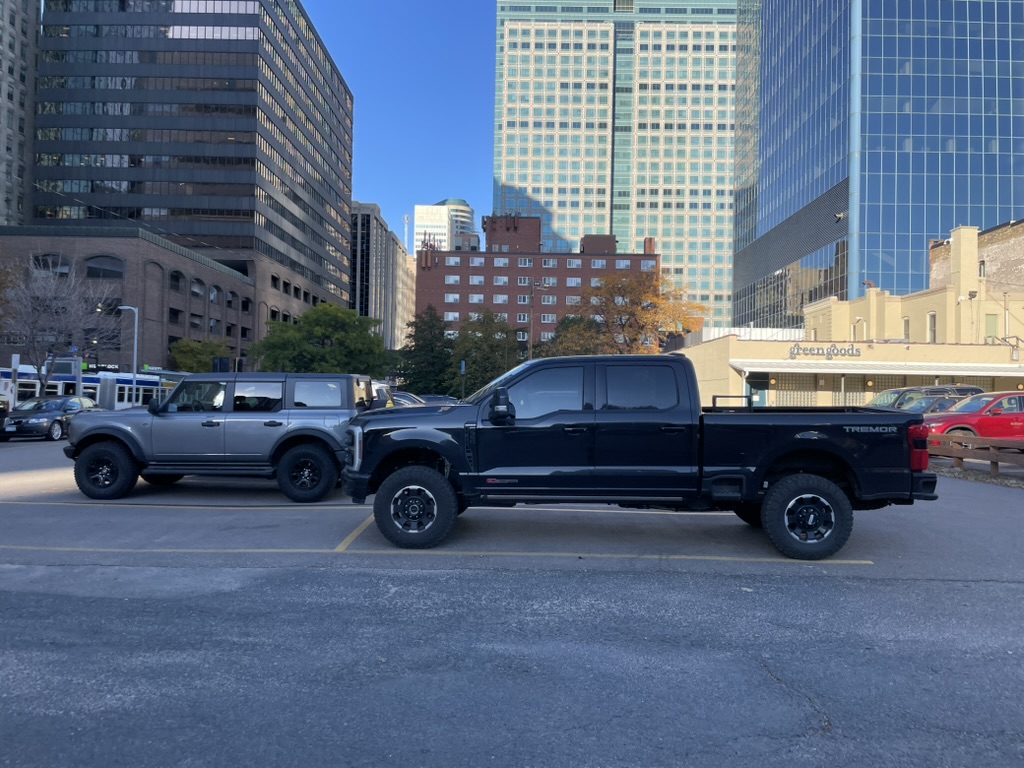
From a parking lot in Minneapolis a block from the ACSP conference.
While I may not do a deep dive into the ethics of care in my dissertation, it’s something I briefly discussed in my presentation and is in many ways a central – if behind-the-scenes – tenet of my research agenda. The ethics of care, developed by feminist philosophers such as Carol Gilligan, Nel Noddings, and Joan Tronto, challenges abstract, universalist moral theories by emphasizing relationality, interdependence, and the moral significance of responding to others’ needs. Rather than centering autonomy or impartial justice, care ethics foregrounds the everyday practices through which people sustain one another and their environments. The ethics of care has been used to inform debates about how to provision education, healthcare, and social policy but has not (to my knowledge) been applied in a mobility context.
I recently read Virginia Held’s book “The Ethics of Care: Personal, Political, and Global” and was curious to see how she framed it. She described its central focus “on the compelling moral salience of attending to and meeting the needs of the particular others for whom we take responsibility” (p. 10, emphasis added). These particular others are captured in scholar Eva Kittay’s conceptualization of the ethics of care, which Held describes as “the very real facts of dependency for everyone when they are young, for most people at various periods in their lives when they are ill or old and infirm, for some who are disabled, and for all those engaged in unpaid ‘dependency work’” (p. 14).
When I think about applying the ethics of care to transportation, I start in a different place. We all rely on many factors to ensure we are able to move through our built environment. Said another way, we are all always dependent on others to navigate our worlds safely. The converse of this is that we are *all* vulnerable when we’re mobile. One look at crash data for 2023, when 32,081 of the 40,901 people who died in crashes were drivers or occupants of cars, reveals that despite what advertisers and cultural narratives tell us, we’re still vulnerable when we’re in cars. Of course, some are fundamentally more vulnerable than car occupants on streets for the simple fact that they are not protected by tons of metal, especially when confronted with tons of moving metal.
But it seems to me that when we talk about vulnerability, particularly vulnerability in a mobility context, we risk characterizing vulnerability as a bad thing. It is only a bad thing when it can kill or injure us. Vulnerability is an innate feature of being human and though this is perhaps our greatest weakness from an evolutionary standpoint – not many animals are dependent on parents for food, transportation, and housing until their late teens, let alone as helplessly reliant on constant adult attention for years after birth – it may also be our greatest evolutionary strength. If it wasn’t for our vulnerability, we would lack not only the capacity for cooperation but the joy of joining with others – for the benefit of others and ourselves. We need not return to the desolate times of COVID to recall how much we value our interdependence. Sadly, many still struggle with social isolation (frequently exacerbated by our screens) and the impacts on our well-being when we are unable to connect meaningfully with others. Indeed, our ability to (truly) connect with others is inherently tied to our ability to be vulnerable, and in turn with our ability to live a good life. Ironically, it seems there is often an inverse relationship between the extent to which we embrace our vulnerability and the vulnerability we ultimately experience.
Of course, the trick is – as with so many things – to find that precious balance and those supportive places where our vulnerability is held and tended to, not exploited. Our current mobility landscape makes what should be a normal – and validating therapists around the world, maybe even celebrated – human experience one defined by danger and detachment. As one of my bike bus interviewees shared:
[The bike bus] is peacebuilding in a way, allowing people to be vulnerable without feeling threatened.
We of course need to address the risk posed by cars: they serve to make us all – but especially road users who are disabled, young, old, low-income, unprotected – vulnerable to their harmful impacts (whether it’s crashes, pollution, or myriad other negative externalities). However, I’m holding out hope that someday in the future, vulnerability isn’t a death sentence but merely the foundation for a more interdependent society, something that connects us to each other and to our humanity. In the meantime, I invite you to get curious – what comes to mind when you imagine a caring transportation system? ✌️🚸

 Peace and Planning
Leave a comment