
I recently had the opportunity to present early findings from my bike bus research at the American Political Science Association (APSA) annual meeting 🤓. Over the summer, I was honored to have spoken with nearly two dozen adult bike bus participants (nearly all volunteering their time and bodies to make the mundane magic of kids walking and rolling through their neighborhoods happen) and to have ridden a dozen community biking initiative routes across six cities in four states. To say that I am fortunate is a massive understatement – I was blown away by the brilliant insights and poignant experiences shared during each hour-long interview and had a difficult time trying to fit all the findings into a 15-minute conference presentation.
Given that I could write a whole dissertation on the interviews and participant observation alone (though it’ll be approximately 1/3 of mine), I will not subject my dear readers to all the goodness that came from that stream of research. That said, one thing that really stood out was on the one hand how starved we are of community and on the other how bike buses and other community biking initiatives have helped to strengthen our severely atrophied social cohesion muscle 💪.
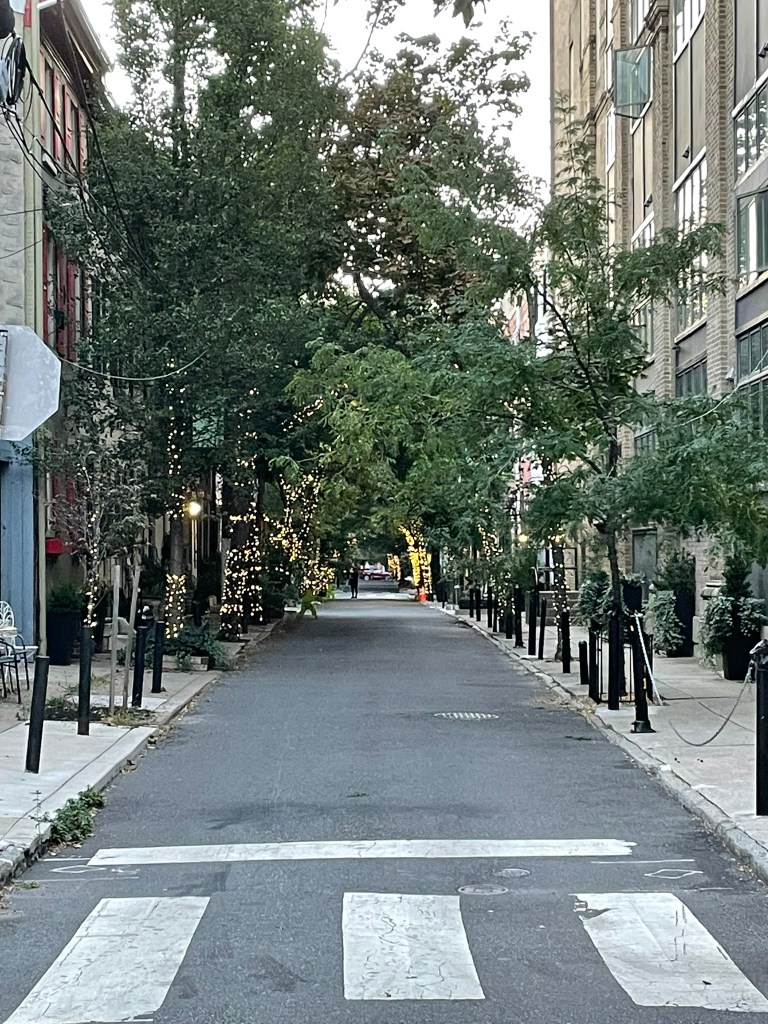
During my presentation and in the few chats during the conference where I attempted my research elevator pitch (nothing like a big room filled with the academic equivalent of peacocks all shaking our tail feathers in the hopes that someone would not walk away while we were pouring out our scholarly hearts 🦚), one term that I used to describe our current transportation landscape was that of a monoculture. As in, we have a monoculture of cars. In most places, it looks like we’ve clear cut the land to make way for a single crop to boost our bottom line as much as possible (and wreak havoc on the world as we go), and that cash crop is cars.
That mental image (and this post) got me thinking about how we talk about our current mobility paradigm as a transportation “system.” What would it mean to talk about it as a transportation ecosystem? Well, in a recent chat with ChatGPT (as one does), I asked what the difference between a system and an ecosystem (especially outside the context of biology) was. Here’s how they framed “system”:
A system is a set of interconnected elements that work together to form a complex whole. It typically has a clear structure and boundaries and is organized to achieve a specific function or purpose.
And here’s how they defined “ecosystem”:
An ecosystem, in a non-biological context, refers to a broader, more fluid network of interacting elements that may include different systems, individuals, organizations, and environments. The focus is often on relationships, interdependence, and adaptability rather than rigid structure.
No wonder we talk about it as a transportation system. While I might not go so far as to say we work together (or rather, we do in the way that you have to work with that miserable person in HR – rather begrudgingly), there is certainly a structure governed by boundaries, and it is organized to achieve the purpose of efficiency and convenience. When we consider what a transportation ecosystem might look like, the focus would (by definition) have to be on relationships, interdependence, and adaptability. The thing is, you can’t have relationships ensconced in a metal box, encased behind tinted windows, lifted several (sometimes many) feet above the ground.
As evidenced in that beautiful word cloud at the top of the post, nearly every interviewee talked about community – whether it was in response to the “what three words would you use to describe the bike bus” question or throughout the interview itself. Community biking initiatives like bike buses show what a transportation ecosystem would look like – one that enables and builds relationships (“hey neighbor! beautiful day, eh?!”), one that recognizes our interdependence (my ability to ride home safely is dependent on you not driving like you own the road), and adaptability (road closed? all good, we can take this alley. flat tire? no worries, you can hop in the front bucket of this cargo bike so long as you don’t mind riding with my dog Snickerdoodle.)
Ultimately, it seems that these hyper-local, collective, people-oriented, participatory, habit-forming, positive, and futures-focused social experiments are ecosystems in the truest sense of the word. They are fostering interactions, and through those interactions – much like a forest or wetland – are forming something greater than the individual.
This work is truly a gift, and not a day goes by that I don’t thank my lucky stars for the chance to engage with this space. Nor does the Earth complete a rotation that I don’t derive enormous inspiration from folks like my interviewees as I continue chipping away at the conundrum of cars on our public streets. Which is a blessing because another conference lies in my midst: the Association of Collegiate Schools of Planning (#ACSP) annual conference is in November where I’ll be presenting my next bit of analysis (this time on the public testimonies of mobility advocates) on the “Big Ideas in Transportation Planning” panel. Good thing I love writing and PowerPoints 🤸🏼♀️ Until next time, I invite you to get curious – what comes to mind when you imagine a peaceful transportation system? ✌️🚸
 Peace and Planning
Leave a comment