In the early 2010s, there was a lot of hype about companies like Lyft and Uber. Because they had a leg-up on their taxi predecessors with their ease of use and ability to pick up multiple passengers along efficient routes, they finally promised the solution to what’s called the “last mile” problem: offering a convenient, ostensibly more climate friendly, and affordable (ignoring, for the moment, the massive amounts of private capital needed to keep those costs artificially low) alternative to connect bus and subway riders between the closest transit stop and their destination. Some thought they would spell the demise of the personal vehicle and in so doing, would also halt the destructive climate impacts of said vehicles.
We’ve now seen what actually happened (ignoring, for the moment, the labor, safety, and other issues they’ve introduced): they ended up being used for the first, last, and in between miles, displacing trips that would have otherwise been taken on non-car modes and not meaningfully reducing vehicle miles travelled or car ownership. Layer on top of that the pandemic which made ride “sharing” a not-so-attractive option, and even that supposed benefit faded away. In short: no climate miracle.

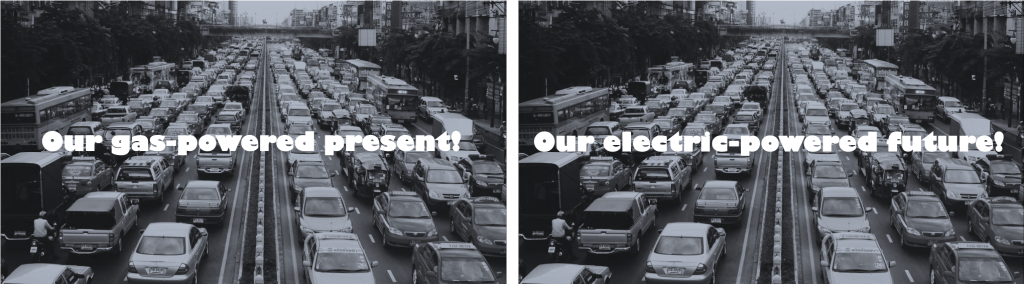
What does this experience tell us about our current options for addressing the massive environmental and climate crisis we face? To put it plainly: electric (and, in case you’re a technoptimist type, autonomous or any other robo) vehicles will not save us. This is not to say that these technologies do not have some benefits, but rather that they are not a panacea and that in some cases, they will exacerbate existing issues. First, the arguments of EV boosters assume that electric will be ubiquitous tomorrow. We know, though, that it will take decades for our current fleet of gas-powered vehicles to be fully retired (especially if people buy EVs but continue to use their gas-powered cars). Even when owners part ways with their internal combustion engine vehicles, they are not likely to be decommissioned to a junk yard (don’t get me started on those), but will be exported to lower-income countries where they will continue to contribute all these negative externalities for years to come in places that already have to shoulder the burdens of our high-carbon lifestyles.
Second, it’s important to distinguish between environmental and climate change effects because so often (and understandably) we focus our attention on looming climate catastrophe. Greenhouse gases contribute to a changing climate and mitigating this is an urgent and significant need; given this, it is surely better to have cars that are not spewing greenhouse gases from their tailpipes. However, there are myriad other environmental impacts that cars – regardless of their energy source – cause:
- Focusing on tailpipe emissions doesn’t account for other pollutants cars create: tire and brake systems release particulate matter, and the heft that electric batteries add to vehicle weights means more wear and tear and more harmful toxins being emitted into our air, water, and soil.
- The increasing weight of vehicles also means we need to repave our roads with greater frequency due to that increased wear and tear. Repaving roads requires using massive amounts of materials like concrete that bear their own environmental costs.
- While autonomous vehicles might more adeptly avoid collisions with wildlife, EVs will still kill millions of animals. While the quieter operation of EVs and AVs may reduce the harms noise pollution causes for wildlife, we’ll still build highways through their habitats, privileging our movement more than theirs.
- Making cars requires a tremendous amount of materials and while EVs will be less resource-intensive than their gas-powered counterparts, these materials aren’t just laying on the ground, waiting for us to come along and scoop them up. Rather, obtaining these materials requires intensely extractive practices (many of which will be concentrated on land stewarded by Indigenous people) which degrade the habitats of flora and fauna, create toxic waste (bad for humans, too!), and require huge amounts of precious groundwater resources.
- We also know that much of our electricity grid still relies on carbon so until we’ve fully transitioned to renewable energy, every charge results in emissions back at the coal-fired power plant. (This is particularly concerning if we consider how much energy is required for all the computing needed in an autonomous vehicle.)
- (While I haven’t yet read this book, it’s on my shelf and no doubt I’ve missed many more impacts to nature and wildlife that should be considered.)
Third, perhaps the most pernicious way that EVs (and any other car-centered technological solution) will not solve our environmental problems begins by considering two complimentary forces: system dynamics and human psychology. These combine to form a cycle wherein we have easy access to what at first glance appears to be a sustainable option, and in turn we tend to make other decisions that perpetuate unsustainable practices that cancel out any advantages we might otherwise realize.
Allow me to explain. I’m not sure if America created suburbia, but it certainly perfected it – indeed, cars and MASSIVE spending to create the interstate highway system enabled our sprawling communities. Despite what appears to be a revival of cities, suburbs remain an alluring prospect for many, especially for those who desire separate bedrooms, ample play space, and large backyards for their kids. When you have a car that makes it seem less bad to drive (in the case of AVs, more convenient), what are you likely to do? Take advantage of lower property values in the hinterlands – it might add a few minutes to your commute or make getting to downtown a bit harder, but you get to live the American Dream with nothing weighing on your conscience, right?
Not quite. Every house built further from a dense urban center requires a lot of additional development – beyond roads (with their carbon-footprint-heavy paving materials), municipalities need to build and operate infrastructure like pipes and poles, care for new landscaping treatments (often after removing existing trees and disrupting local animal populations, which doesn’t even account for your own lawn care), construct new civic spaces (which are likely to take up more space than they otherwise might given those cheaper land values) like schools and community centers, provide services like emergency response (which requires longer travel times and more vehicles on the road to meet demand over a larger area), support the needs of new business ventures, and of course – lest we forget – provide a deluge of free parking wherever anything is built, among other things. (Want more on parking? This video has got you covered.)
Of course, every time you go anywhere, you must get into your car…and in fact, you’re happy to get into your car because you’re saving the planet! Except…not. Because you are not the only person in the world – other people are also seeking their slice of the American Dream, so they move to your neighborhood. And then it gets a little too congested (thanks induced demand!), a little too busy, a little too overcrowded, a little too expensive. This then prompts a new wave of people pursuing the picket fence to take a new set of developers up on offers for 3 bedroom homes on an acre of land in the brand new subdivision in the sleepy town just beyond yours…but because they have the newest technologies that let them travel by car with even more literal (and existential) ease, it’s all good!(?) Around we go.
One important note: I deliberately focused on the environmental burdens of these technologies because popular media so often fails to paint a more complete picture of the true cost of their uptake. However, one of the things that can be frustrating about the climate and environmental movement is that in their zest for pursuing solutions to their (important, urgent) issues, they overlook all of the other problems that their silver bullet fails to address – community cohesion (we’ll still be isolated in our metal boxes), public health (we’ll still be sitting for long periods of time), economic development (we’ll still be driving through communities rather than being in them), social equality (all that fancy is expensive!), fights over who should get precious road space, people who turn into their worst selves when they get behind the wheel (I’m *very* curious to see if AVs make drivers openly despise other road users any less)…and EVs will certainly not result in a decrease in road fatalities (perhaps the only possible win for AVs could be that they reduce crashes, but we have a long way to go until that reality is realized, especially for those of us pesky humans who don’t look or act like cars). Ultimately, these technologies will not succeed in addressing most of the other negative externalities cars pose to society.
I started the post with some bad news, but we needn’t sink too far into despair. The good news is that we *do* have an answer, and we’ve had the technological solutions for more than 100 years. It starts with building dense, mixed-use communities (take a seat, NIMBYs!). It continues with creating safe, connected, and comfortable infrastructure and services for pedestrians, wheelchair riders, bicycle/micromobility users, and public transit riders. It involves making meaningful investments in rail so that we can reliably, quickly, and affordably take longer trips without relying on our cars (or flights, for that matter). At first glance, this seems like it will take unthinkable sums of cash but when you consider how much we spend on car infrastructure (especially compared to, for instance, public transit), it doesn’t seem so outlandish.
Of course, these answers are not the easy answers. They will involve a fundamental challenge to our investments, policies, economic systems and industrial incentives, built environment, and even our notions of what it means to be successful and to be an American. And that’s just the structural and cultural issues that need to be tackled – of course it will take us all making different individual decisions, changing our habits, making “sacrifices,” and the like. However, we must also think of what we could gain. We could actually make a dent in our carbon output while also enjoying safe, healthy, equitable, connected, prosperous, and – dare I say – joyful communities.
Until next time, I invite you to get curious – what comes to mind when you envision more peaceful streets? ✌️🚸
For research articles on this topic, see:
Hawkins, T. R., Gausen, O. M., & Strømman, A. H. (2012). Environmental impacts of hybrid and electric vehicles—A review. The International Journal of Life Cycle Assessment, 17(8), 997–1014. https://doi.org/10.1007/s11367-012-0440-9
Henderson, J. (2020). EVs Are Not the Answer: A Mobility Justice Critique of Electric Vehicle Transitions. Annals of the American Association of Geographers, 110(6), 1993–2010. https://doi.org/10.1080/24694452.2020.1744422
Liu, W., Agusdinata, D. B., Eakin, H., & Romero, H. (2022). Sustainable minerals extraction for electric vehicles: A pilot study of consumers’ perceptions of impacts. Resources Policy, 75, 102523. https://doi.org/10.1016/j.resourpol.2021.102523
Morfeldt, J., Davidsson Kurland, S., & Johansson, D. J. A. (2021). Carbon footprint impacts of banning cars with internal combustion engines. Transportation Research Part D: Transport and Environment, 95, 102807. https://doi.org/10.1016/j.trd.2021.102807
Sacchi, R., Bauer, C., Cox, B., & Mutel, C. (2022). When, where and how can the electrification of passenger cars reduce greenhouse gas emissions? Renewable and Sustainable Energy Reviews, 162, 112475. https://doi.org/10.1016/j.rser.2022.112475
 Peace and Planning
Leave a comment