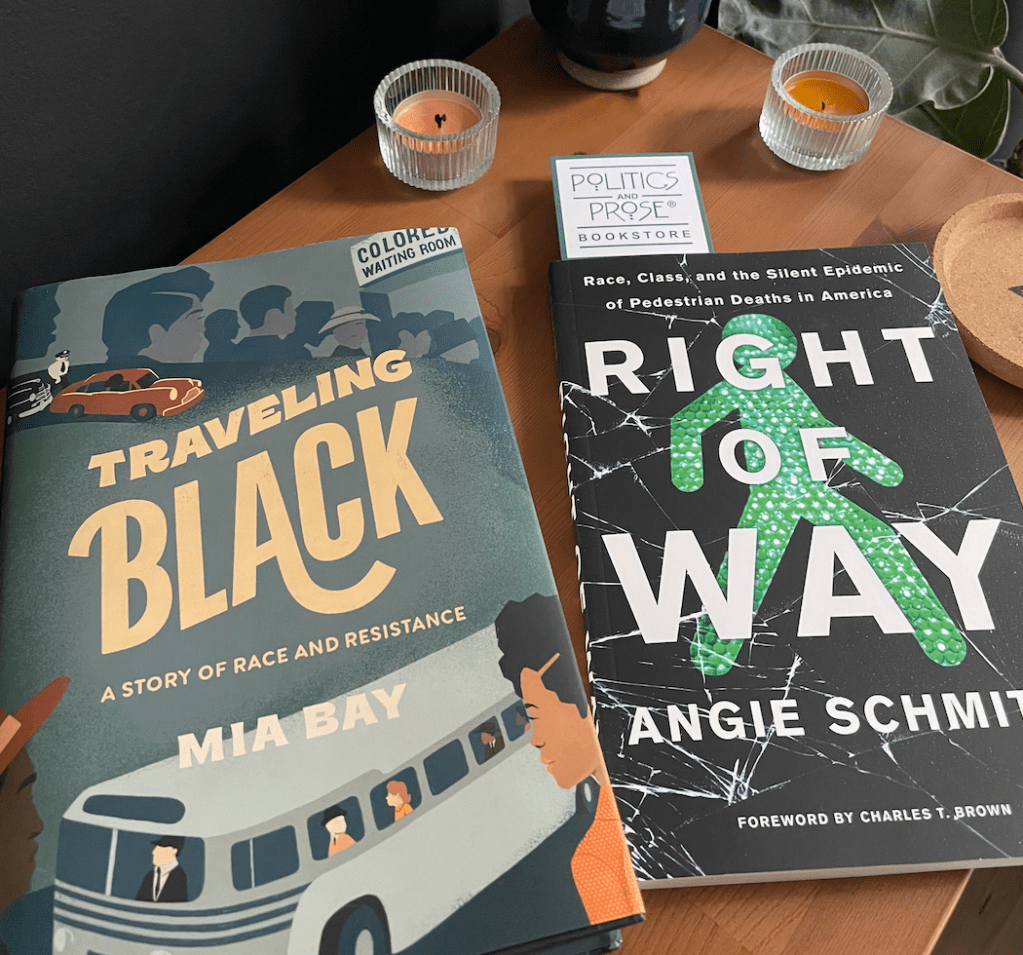
For my Conflict and Race class this semester, my favorite assignment was to read two books of my choosing and then create a discussion guide about them. I selected two recent reads: Traveling Black: A Story of Race and Resistance by Dr. Mia Bay and Right of Way: Race, Class, and the Epidemic of Pedestrian Deaths in America by Angie Schmitt. I would *highly* recommend both (they pair nicely together, and I’d start with Traveling Black) as they shed light on just how far we’ve come – and how far we have to go – for transit justice in this country. Since I don’t envision teaching a class on transportation, conflict, culture, and identity anytime soon (but wouldn’t that be SO COOL?!?!), I’m sharing the discussion guides here in case they’re of interest to anyone!
Traveling Black presents a historical deep dive on the experience of Black Americans utilizing different modes of transportation, the oppression they faced as well as the campaigns they’ve waged over generations to seek transit justice. I was interested in this book because as someone who lives in DC and spends a lot of time thinking about local transportation policy, I wanted to have a firmer grasp of the lived experience of Black Americans navigating their built environment after my interests had been initially piqued reading Avidly Reads Passages and The Warmth of Other Suns. The two discussion guides are largely structured similarly – both open with a brief overview of the author and book and close with discussion questions and activities, but in the case of Traveling Black I opted to include a quotation from each chapter. This was probably the hardest part of the whole assignment because there were so many cringe-worthy quotations that really highlighted how pernicious transportation injustice has been – and continues to be, as Bay closes with an epilogue that sketches a picture of the contemporary transportation challenges plaguing Black Americans.
Bay’s epilogue offers a nice jumping-off point to Schmitt’s work, which it’s important to note was published in 2020 and thus does not reflect disheartening trends witnessed during the pandemic. For Right of Way, I opted to instead include statistics that were noteworthy, but again this was difficult given that at some point I had to tell myself that I couldn’t highlight every tidbit of information shared because it was jam-packed with research and I’d just be highlighting every page. There are too many key takeaways to list here but suffice it to say: we must completely overhaul how we design our streets, policies, and news stories to protect vulnerable pedestrians. In the meantime, do yourself a favor and just read it.
 Peace and Planning
Leave a comment